The Project: A Unique Approach to Music Theory
This project started from a personal frustration: I wanted to translate the chords I knew on the guitar, to the piano, and any existing tool that I tried just didn’t help. Since launching the latest version in December 2025, the app has had over 5,000 visits, with roughly 600 unique visitors in the last month alone (as of writing this on Feb 15, 2026).
My Role
I thoughtfully designed, and coded every version of this app. The original was built for Mac/iOS in 2020, and at the end of 2025, I rebuilt it as a React web app using Claude Code as an experiment in AI-assisted development. This is the version that is available today.
The Problem: Sheet Music Isn’t Straightforward
Many guitar players — myself included — have limited or no knowledge of how to read sheet music. Most guitar players learn through tablature (tab), a system that visually maps strings and frets. Standard notation, which is how most music is communicated, requires a completely different type of memorization to correlate to a piano.
Two Different Languages
Guitar tab and standard notation are essentially two different languages. If you learned guitar through tab, picking up piano is daunting because there is no direct visual translation between the two systems.
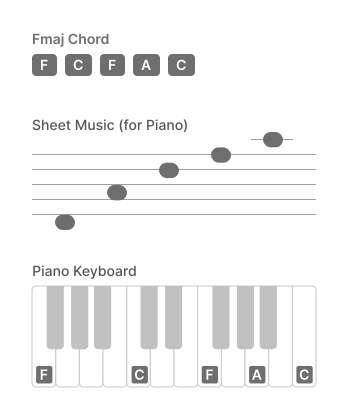
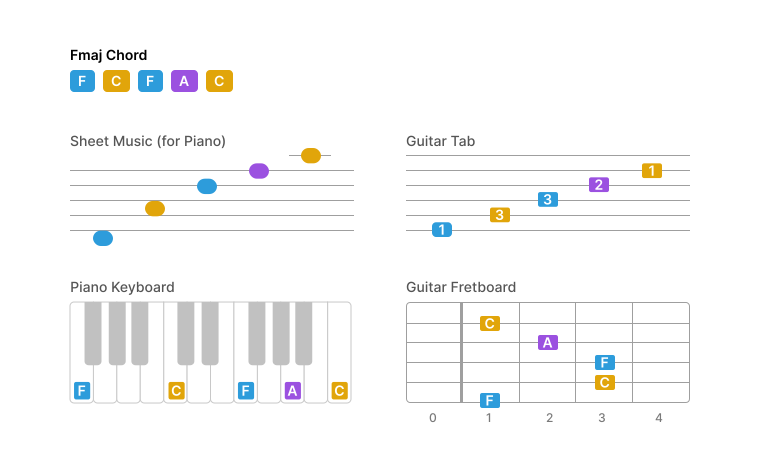
Here are examples of both: guitar tab mapped onto a fretboard, and sheet music mapped onto a piano keyboard.
There Is No Visual Translation
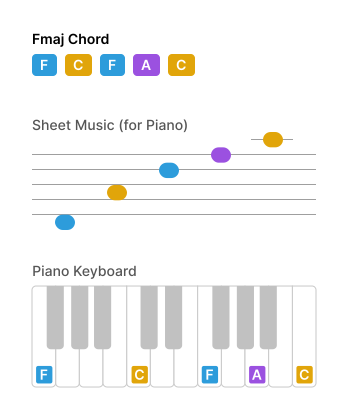
As you can see, correlating sheet music to a piano keyboard is difficult. You must memorize the notes and their positions on the keyboard, and how they relate to the positions on the lines in the sheet music. Colour helps the brain make connections, but sheet music doesn’t have this aid since it is always written in black and white.
Guitar Tab Is Simplified
Because tab is a number-based system, many guitar players don’t actually know what notes they’re playing. They know the fret positions, but that doesn’t help them translate what they’re playing to piano. This was a conundrum I shared with many other musicians, and where I hoped to find an alternative to learning how to read sheet music.
My Hypothesis: An Alternative Way to Translate
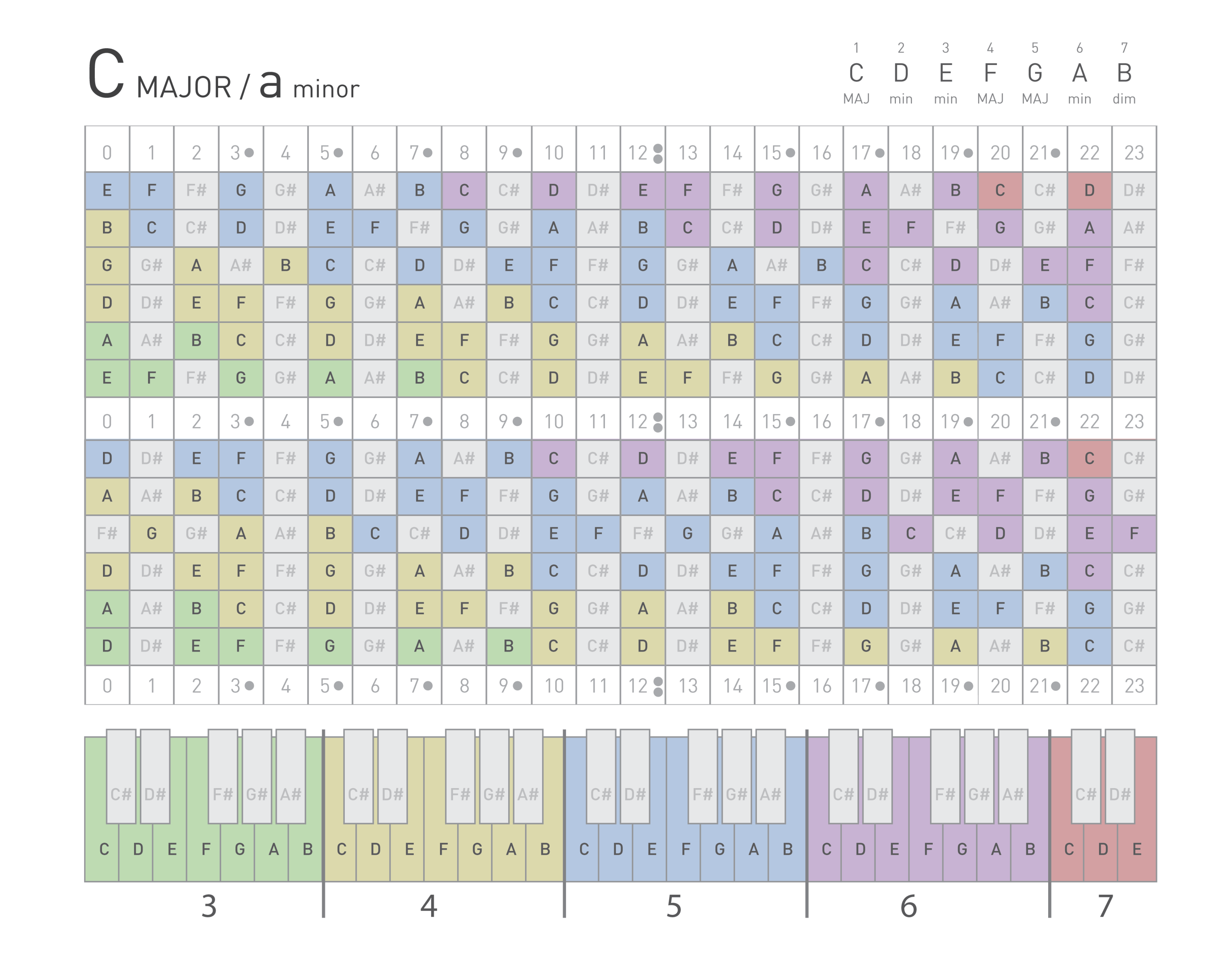
In 2018, I started by creating colour-coded charts for each major and minor key, covering both standard tuning, and an alternative tuning I use frequently in my music.
When I shared the charts on Reddit, they received over 400 upvotes and ~60 comments. There was clearly demand, but people, myself included, wanted more than static charts.
Adding More Functionality
In 2019, for my final project in University, I designed and coded an iOS app that expanded on these charts. Users could select notes on either instrument to translate between them, and configure views for keys, chords, and scales.
I learned a lot from building an app on my own, but I never kept up with Apple’s library updates, and eventually it stopped launching. It was nearly five years before I ever revisited it.
Where It Stands Today:
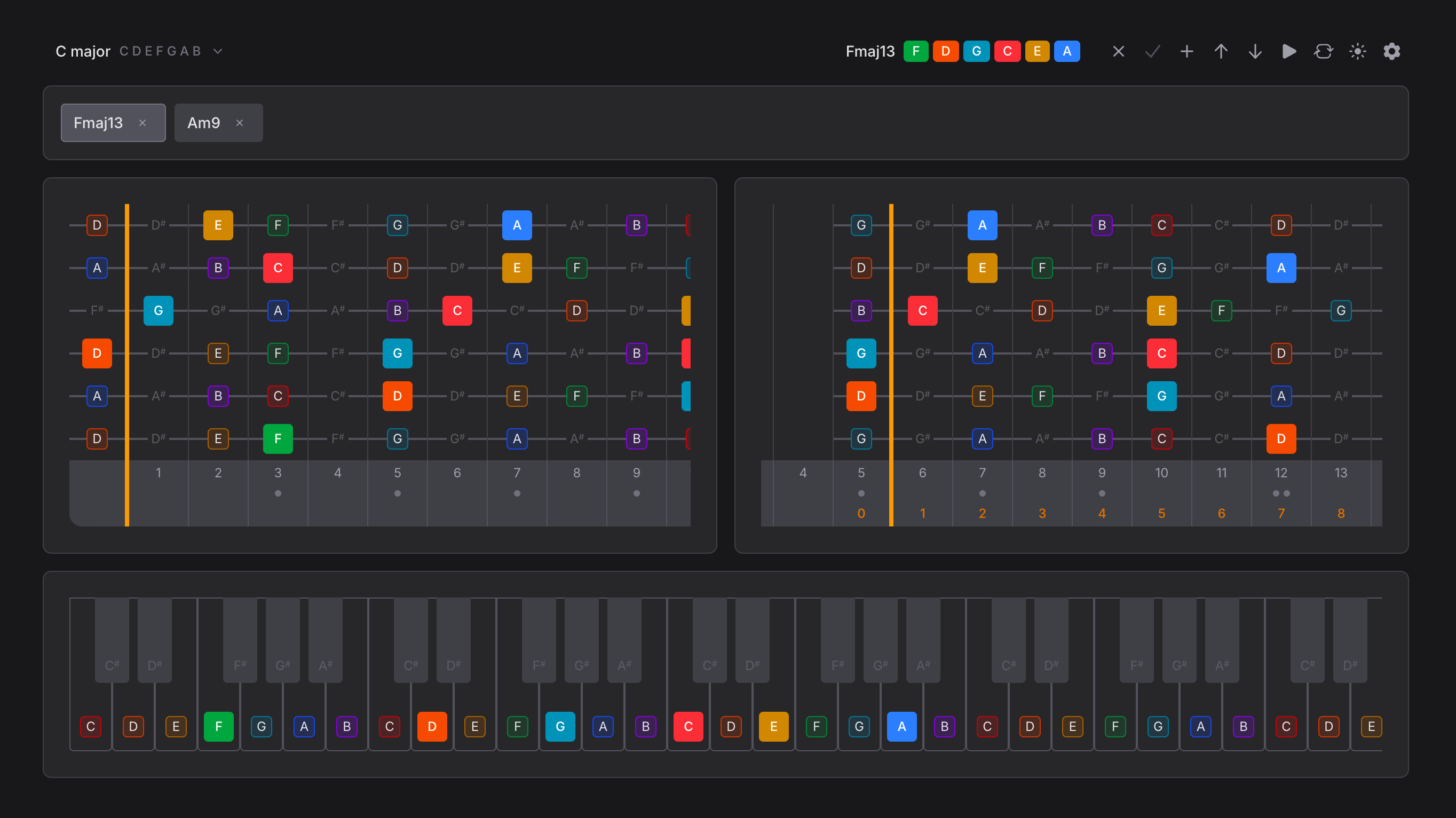
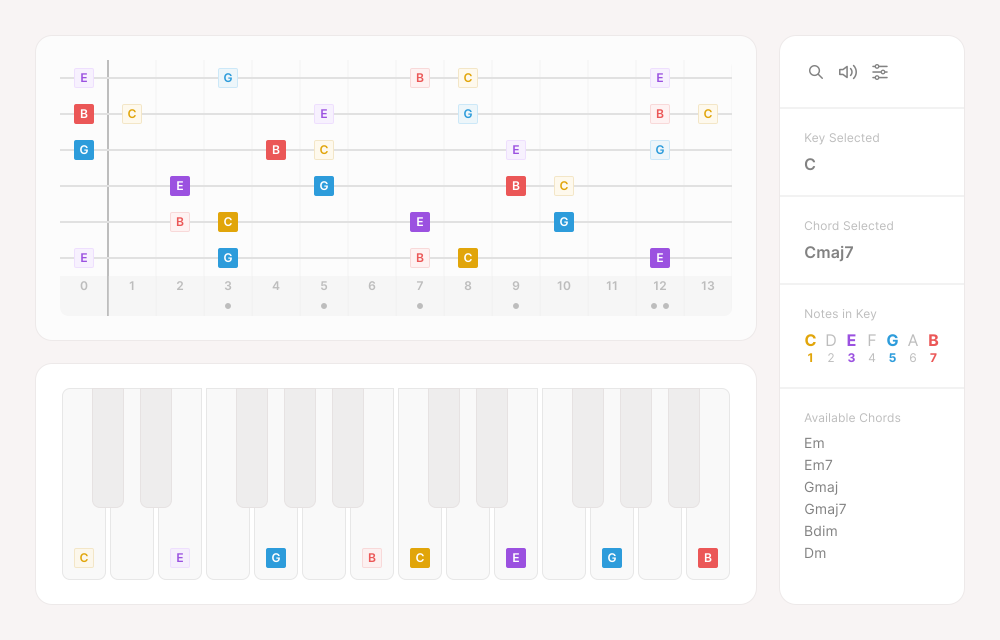
In late 2025, I used Claude Code to rebuild the app as a React web application. Having years of design reference and interaction patterns ready to go, I was able to rebuild the core functionality in a few days, and pushed it well beyond the original feature set — adding functionality I had wanted for years, but never made time to implement.
Here is the app as of February 2026.
Conclusion
I have been using variations of these charts and tools for about 8 years, and since launching the web version, multiple people have reached out to tell me they use it as a teaching aid in music theory classes and private lessons. Other musicians have said they’d been looking for something like it for years.
What started as a tool to solve my own problem, has grown into something that is genuinely useful to others — that, by far, has been the most rewarding part of this project.
 Designer
 My Home
 Started in 2018